Pages

Wednesday, February 07, 2007

What Are You Chasing?

Each Wednesday I post my article from "Winning Ways," an e-newsletter that goes out to over 750 subscribers. If you want to subscribe to "Winning Ways," sign up here.

Our Declaration of Independence tells us that “the pursuit of happiness” is a fundamental human right. But if you don’t know what will really make you happy it’s futile to pursue it.

I read about an enterprising lady in New York City, where there are very few places to bury a deceased pet. The city authorities will take your pet off your hands for $50, but for a while there was a woman who advertised the same service for half the price. When she got a call, she showed up at the client’s apartment with a second-hand suitcase she had purchased at the Salvation Army for two dollars. She would gently place the deceased pet in the luggage and leave the apartment. Then she would take a ride on the subway, setting the suitcase down and acting like she wasn’t watching. Invariably a thief would steal her suitcase, and she would look up and say, “Wait. Stop. Thief.”

Her problem got solved, but my guess is the people who stole those suitcases got a real surprise when they got home!

Some of us are like those New York thieves. We keep grabbing what we think will give us happiness, but we end up with something that doesn’t quite deliver. Maybe that’s why only 20% of the people in the U.S. claim to be happy according to one study. The right to pursue happiness is no guarantee that you will find it.

That’s why we’re going to look at Jesus’ definition of happiness the next four weeks at Hillcrest. In our study through the Gospel of Matthew, we’ve reached the famous Beatitudes. Eight times Jesus declared certain people “blessed” and explained why.

The Beatitudes stand alongside the Ten Commandments and the Lord’s Prayer and Psalm 23 as the most beloved passages of the Bible. But what do they really mean?

That’s what philosopher Dallas Willard asked in his award-winning book, The Divine Conspiracy. “The Beatitudes are acknowledged by almost everyone to be among the highest expressions of religious insight and moral inspiration,” he said. “We can savor them, affirm them, meditate upon them, and engrave them on plaques to hang on our walls. But . . . how are we to live in response to them?”

For the next four Sundays we’ll figure out how to answer that question in a study called “The Pursuit of Happiness.” Join us at Hillcrest (9:30am or 10:45am) if you're in the Austin area, or listen to the sermon podcast (iTunes; website) posted Monday.

Tuesday, February 06, 2007

Links to Your World--Tuesday February 6

In this Texas Monthly article, discover 10 resolutions for healthy eating. I knew several of them already, but some were a surprise.

In last week’s sermon I quoted from Steven Weinberg’s review of Richard Dawkins book, The God Delusion. You can find that article here.

If you don’t know how to leave your church and you decide the only way you can do it is to fake your own death, here’s a hint: don’t attend the memorial service.

See the progress on a South Austin mural, updated regularly here.

This article points out that surfing the internet has become a favorite hobby for older adults.

Here’s an Associated Press article about LifeBox, the program we’re leading in our area to express support and outreach to our troops.

“Imagine that you were a college student, and pregnant,” Serrin M. Foster says. “So you go to the university health services for advice. Two of the employees there, university employees, recount to you the embarrassment and inconvenience associated with pregnancy. If you do decide to have the child, they explain to you, the university will almost certainly give you no support; it will do nothing to make things easier for you. And then they urge you to have an abortion.” In this article, Foster points out that some journalists went undercover and discovered that this kind of thing happens all the time. I thought abortion advocates wanted to give women all their options.

Monday, February 05, 2007

On-Mission Mondays: Get Real

Every Monday I post about being “on mission” with Christ. I’ll spend a couple of months asking you to think with me about the principles in Milfred Minatrea’s book, Shaped By God's Heart: The Passion and Practices of Missional Churches . Find previous posts on this subject by clicking the label “On-Mission Mondays” at the end of this entry.

"Our world is tired of words -- it wants real."

That's one of the convictions that drives Robert Lewis at Fellowship Bible Church in Little Rock. And Minatrea says that's the second practice of missional churches. He says we need to be authentic in our faith, authentic with one another, and we need to act authentically in the world.

Authentic in Our Faith. Minatrea says that many people “perceive the church to be a head trip that never touches the heart.” Instead, discipleship touches every part of our lives and has implications everyday of the week.

Authentic with Each Other. Minatrea provides several examples of churches where disciples are free to be open with each other and challenge each other. This happens best in small-group ministry. For example, Antioch Community Church in Waco encourages their small groups to interact with one another in seven areas that are based upon the New Testament: love one another, serve one another, spend time with one another, allow others to be imperfect, build one another out, have a gentle heart toward others and difficulty, and be in unity with one another.

Authentic Actions in the World. Robert Lewis at Fellowship Bible Church challenges his people to “present living proof of a loving God to a watching world.” Minatrea says of believers, “When their faith transforms the way they live and react every day, then it merits the world’s attention.”

What are the ways your congregation encourages this kind of authenticity?

Saturday, February 03, 2007

And Now For Something Completely Different . . .

Things have gotten too serious at "Get Anchored." To change the pace, here's a group of kids at the Granbury High School talent show(Granbury, Texas). My neices attend this school. In fact, one of them had a routine in this same show. But it's this cool treadmill dance that's making YouTube fame:

Mike Huckabee (Part 4): Gay Rights

Mike Huckabee has begun his presidential campaign. He presented himself well promoting his book on "The Daily Show with Jon Stewart" (see it here). What do you think of his candidacy? Here is his response to questions from Tim Russert on Meet the Press regarding gay rights:

MR. RUSSERT: You said this to the Des Moines Register: “Let’s face it. In our lifetimes, we’ve seen our country go from ‘Leave it to Beaver’ to ‘Beavis and Butt-head,’ from Barney Fife to Barney Frank.” Why, why include Barney Frank, a gay congressman, in that reference?

GOV. HUCKABEE: I think it was a matter of a rhetorical device to talk about the different cultural shift that we have, and it wasn’t any particular attempt to be derisive of him. But, but there has been a huge cultural shift in this country, Tim. And I think that’s why many Americans are seeking leadership that has a positive and optimistic spirit, that wants to take this nation—what I call vertical politics rather than horizontal.

I just completed a book in which I talk about the difference between horizontal politics, where everything is left or right, everything is liberal or conservative, everything is Democrat or Republican. I think the American people are hungry for vertical politics, where we have leaders who lift us up rather than those who tear us down.

MR. RUSSERT: But some would suggest by including Barny Frank in that reference you are tearing a gay man down. You’re against gay marriage, you’re against gay civil unions. Is—do you have a problem with gay people?

GOV. HUCKABEE: No. I have a problem with changing institutions that have served us. And I, I think I would rather characterize not what I’m against, but what I’m for. Before we change the definition of marriage to mean something different, I think our real focus ought to be on trying to strengthen heterosexual marriages because half of them are ending in divorce. That’s a real problem in this country. There are a lot of kids who are growing up in a very, very confused and conflicted world because—not because we have same-sex marriage, but because we’re seeing a real failure in the tradition heterosexual marriage. That’s where our focus needs to be. Because if we want to end poverty, get a kid through high school, let him grow up in a stable, two-parent home and make sure that that child doesn’t have a child before he’s 21 and has a full-time job. That’s a 93 percent chance that child will never grow up in a single day of poverty if those are the criteria.

MR. RUSSERT: Should...

GOV. HUCKABEE: So we ought to be working more to build strong families rather than just to create new versions of them.

MR. RUSSERT: Should gay couples be allowed to adopt children?

GOV. HUCKABEE: That’s a question that, that I think, again, goes back to the heart of what’s best for the child. Unfortunately, so much of this argument has been framed about what, what the same-sex couple wants. But the real question needs to be child-focused, not couple-focused. And, Tim, that’s true for whether the couple is same-sex or whether they’re heterosexual. In our state, as in most, the criteria for adoption is always what’s in the best interest of the child. That ought to be what’s front and center.

MR. RUSSERT: So is it in the interest—best interest of the child to have a gay, gay parents?

GOV. HUCKABEE: That’s a question I’m not sure that, that we have a positive answer to. And until we absolutely could say it, then, then I—I’m always hesitant to change those institutions.

MR. RUSSERT: Do you believe that you’re born gay or you choose to be gay?

GOV. HUCKABEE: I don’t honestly know. I really don’t. I think there are—there are people who would argue vociferously on both sides of that. But I think that the point is, people are, are who they want to be, and we should respect them for that. But when they want to change the institutions that’ve governed our society for all the years of recorded human history, then that’s a serious change of, of culture that we, we don’t just make readily or, or hurriedly. It has to be done with some, some deep thought.

Mike Huckabee (Part 3): Abortion

Mike Huckabee has begun his presidential campaign. He presented himself well promoting his book on "The Daily Show with Jon Stewart" (see it here). What do you think of his candidacy? Here is his response to questions from Tim Russert on Meet the Press regarding abortion:

MR. RUSSERT: South Dakota had some proposed legislation to outlaw all abortion except saving the life of a mother, no exceptions for rape or incest. You said you’d sign that. Why?

GOV. HUCKABEE: Well, I always am going to err on the side of life, Tim. I believe life is precious. But I think the issue for many of us who are in the pro-life camp—and I have been since, you know, I was a teenager. This is not something that I’ve been all over the board on, it’s consistent. It’s because of my view that God is the creator and instigator of life. But I think those of us in the pro-life movement, we have to do also some growing and expanding. We have to remind people that life, that we belive it begins at conception. It doesn’t end at birth. And if we’re really pro-life we have to be concerned about more than just the gestation period. As a pro-life person, as a governor, look at my record. Yes, did we pass pro-life legislation? We did. But we also did things that improved the environmental quality and the conservation issues that would affect a child’s air and water. We also made sure that he had a better education, that access to affordable health care would be better. So I think that real pro-life people need to be concerned about affordable housing, we need to be concerned about safe neighborhoods, access to a college education. That, for me, is what pro-life has to mean.

MR. RUSSERT: But if you outlawed abortion, what would happen to the doctor who performed an abortion? What, what would happen to the woman who had an abortion?

GOV. HUCKABEE: Well, I think the question is, would I sign the bill in South Dakota? Do I think it’s the best only bill that ever could be signed? The question still comes back to this is a debate that’s been so divisive, and what we really need to be doing is having the discussion center around how can we create a culture where people value and celebrate life. The fundamental difference between the United States and our enemies in terror is that, regardless of whether one is considered pro-life or pro-choice, the one thing that—that is unique to America, or certainly characteristic of America, is that we celebrate life. We believe in it; we cherish it. We may have different definitions of it, what it means and how extensive we want to protect it. But the enemy on the other hand celebrates death. That’s where we need to bring this debate, is to remind ourselves that we still are a nation that elevates the concept that life is precious and important. And I hope that we can center on those topics rather than on the, the fine points that sometimes separate and divide.

MR. RUSSERT: But, as president, you would seek to ban abortion.

GOV. HUCKABEE: I would seek always to promote the view that life is precious and should be protected. Would I be able to singularly do that? Of course not. But I think it has to be won on, on a battlefield of one heart at a time rather than pieces of legislation at a time.

Mike Huckabee (Part 2): Personal Faith and Public Policy

Mike Huckabee has begun his presidential campaign. He presented himself well promoting his book on "The Daily Show with Jon Stewart" (see it here). What do you think of his candidacy? Here is his response to questions from Tim Russert on Meet the Press regarding the role that a candidate's faith should play in public policy:

MR. RUSSERT: I was reading a lot about you, an ordained Baptist minister.

GOV. HUCKABEE: Yes.

MR. RUSSERT: I want to ask you a couple things that you said earlier in your political career. “Huckabee ... explained why he left pastoring for politics. ‘I didn’t get into politics because I thought government had a better answer. I got into politics because I knew government didn’t have the real answers, that the real answers lie in accepting Jesus Christ into our lives.’” And then this: “I hope we answer the alarm clock and take this nation back for Christ.” Would you, as president, consider America a Christian nation and try to lead it as—into a situation as being a more Christian nation?

GOV. HUCKABEE: I think it’s dangerous to say that we are a nation that ought to be pushed into a Christian faith by its leaders. However, I make no apology for my faith. My faith explains me. It means that I believe that we’re all frail, it means that we’re all fragile, that all of us have faults, none of us are perfect, that all of us need redemption. We are a nation of faith. It doesn’t necessarily have to be mine. But we are a nation that believes that faith is an important part of describing who we are, and our generosity, and our sense of optimism and hope. That does describe me.

MR. RUSSERT: But when you say...

GOV. HUCKABEE: I’m appalled, Tim, when someone says, “Tell me about your faith,” and they say, “Oh, my faith doesn’t influence my public policy.” Because when someone says that, it’s as if they’re saying, “My faith isn’t significant, it’s not authentic, it’s not so consequential that it affects me.” Well, truthfully my faith does affect me. But it doesn’t make me think I’m better than someone, it makes me know that I’m not as good as I really need to be.

MR. RUSSERT: But when you say “take this nation back for Christ,” what does that say to Jews, Muslims, agnostics, atheists? What...

GOV. HUCKABEE: Well, I think I—I’d probably phrase it a little differently today. But I don’t want to make people think that I’m going to replace the Capitol dome with a steeple or change the legislative sessions for prayer meetings. What it does mean is that people of faith do need to exercise their sense of responsibility toward education, toward health, toward the environment. All of those issues, for me, are driven by my sense that this is a wonderful world that God’s made, we’re responsible for taking care of it. We’re responsible for being responsible managers and stewards of it. I think that’s what faith ought to do in our lives if we’re in public service.

Mike Huckabee (Part 1): Iraq

Mike Huckabee has begun his presidential campaign. He presented himself well promoting his book on "The Daily Show with Jon Stewart" (see it here). What do you think of his candidacy? Here is his response to questions on Iraq from Tim Russert on Meet the Press:

MR. RUSSERT: Let’s try to define who you are. The last time we talked it was on a—my CNBC show. I asked you about George W. Bush, and you said this, “I think the president has done a magnificent job. And generally, you know, I don’t find that many areas where I would disagree with him.” You still hold that view, Bush has done a magnificent job?

GOV. HUCKABEE: Well, I think he’s had a lot of struggles, particularly in managing the, the war in Iraq. We did a great job of going in and toppling Saddam Hussein. The tough part has been bringing some sense of stability there. And so it’s been a struggle for the president. I think the domestic agenda has also been something that’s almost been ignored and overlooked because we have spent so much of a time on Iraq.

MR. RUSSERT: If you were in the Senate or the House, would you vote to oppose the president sending more troops to Iraq?

GOV. HUCKABEE: I think that’s a dangerous position to take, to oppose a sitting commander in chief while we’ve got people being shot at on the ground. I think it’s one thing to have a debate and a discussion about this strategy, but to openly oppose, in essence, the strategy, I think that can be a very risky thing for our troops.

MR. RUSSERT: Is there one area you disagree with President Bush?

GOV. HUCKABEE: On Iraq or on...

MR. RUSSERT: On anything.

GOV. HUCKABEE: Well, I think we need to be very careful about the overuse of the Guard and the Reserve in our military. As a governor for 10 ½ years and commander in chief of our Guard, I’ve seen 80 percent of our Guard forces deployed to Iraq. Now we’re talking about sending them back yet again and again. These are citizen soldiers. They didn’t sign up to be gone all the time. They signed up to be soldiers called upon for extraordinary duty, and they’ll—they’ve done it. They’re willing to do their duty, but the toll that it’s taking on their families, their employers and their communities is—it’s beginning to really wear.

Friday, February 02, 2007

Happy Groundhog Day

"When Chekhov saw the long winter, he saw a winter bleak and dark and bereft of hope. Yet we know that winter is just another step in the cycle of life. But standing here among the people of Punxsutawney and basking in the warmth of their hearths and hearts, I couldn't imagine a better fate than a long and lustrous winter."

Phil Conners (Bill Murray)
Groundhog Day (1993)

The Wisdom of Looking Ahead

Each Thursday I post my article from "LeaderLines," an e-newsletter designed for church leaders. (I missed yesterday's posting.) If you want to subscribe to "LeaderLines," sign up here.

In a recent Christianity Today article, Rick Ezell advised leaders to “create their organizational future before it happens.” Ezell is senior pastor of Naperville Baptist Church, Naperville, Ill. He wrote:

Bill Walsh, the former head coach of the San Francisco 49ers, was thought eccentric because of how extensively he planned his plays in advance of each game. Most coaches would wait to see how the game unfolded, then respond with plays that seemed appropriate. Not Bill Walsh. Walsh would pace the sidelines with a big sheet of plays that his team was going to run, no matter what. He wanted the game to respond to him.

Walsh won a lot of Super Bowls with his "eccentric" proactive approach. But all he did was to act on the crucial difference between creating and responding. He was a coach that looked into the future.

Effective leadership not only requires thinking about where the organization needs to go, but also looking at how it will get there. We look ahead so we won't get behind. Only by seeing the invisible can we attempt the impossible.

The wisest person of all instructed, "The wise man looks ahead" (Prov. 14:8 LB).

The critical need of looking ahead is the process of creating your organizational future before it happens. Like Bill Walsh, it is creating your own actions in advance so that your life will respond to you. It is attempting to write history in advance.
Ezell explains seven advantages of thinking about where your organization is going, and where it needs to go.

Looking ahead gives direction. It “helps one determine the few things that are worth doing, and worth doing well.”

Looking ahead helps us to create rather than react. Ezell points out that “creation” and “reaction” are actually anagrams--they have the same letters in them. “Each step along our journey we are faced with a choice either to create or to react.”

Looking ahead saves time.

Looking ahead allows us to build on their strengths. “Effective leaders determine what the organization can do best and then do it.”

Looking ahead reduces crisis. “The two controlling influences will be either our plans or our pressures. And contrary to public opinion, no one works well under pressure for long.”

Looking ahead gives energy. “Failing to focus, we dissipate our energy on less important matters, improper agendas, and lost crusades.”

Looking ahead is a spiritual experience. “Looking ahead cannot be done without the power of prayer. As your eyes engage the plan, allow your heart to engage the Heavenly Father.”

Good advice. For the full article, click here.

Tom

Wednesday, January 31, 2007

Song of the Week: Waiting for My Real Life to Begin

My oh my.

My brother introduced me to this song from Colin Hay, "Waiting for My Real Life to Begin." How many of us can identify with the guy waiting for everything to work out the way he wants, while he has a significant person in his life (wife? friend? The Spirit?) saying, "Live now . . . you're missing it now." Selah--

Any minute now, my ship is coming in
I'll keep checking the horizon
I'll stand on the bow, feel the waves come crashing
Come crashing down, down, down, on me

And you say, be still my love
Open up your heart
Let the light shine in

But don't you understand
I already have a plan
I'm waiting for my real life to begin

When I awoke today, suddenly nothing happened
But in my dreams, I slew the dragon
And down this beaten path, and up this cobbled lane
I'm walking in my old footsteps, once again

And you say, just be here now
Forget about the past, your mask is wearing thin

Let me throw one more dice
I know that I can win
I'm waiting for my real life to begin

Any minute now, my ship is coming in
I'll keep checking the horizon
And I'll check my machine, there's sure to be that call
It's gonna happen soon, soon, soon
It's just that times are lean

And you say, be still my love
Open up your heart, let the light shine in

Don't you understand
I already have a plan
I'm waiting for my real life to begin

Fishing for People

Each Wednesday I post my article from "Winning Ways," an e-newsletter that goes out to over 750 subscribers. If you want to subscribe to "Winning Ways," sign up here.

Warren Whitaker admits it's the most unusual way he's ever used to land a fish, but it worked.

While competing in the Texas Outdoor Adventure Series Big Bass Championship a few years ago, Whitaker latched on to a bass he knew would be a winner. He also knew it would be a problem. The big bass had wrapped Whitaker's 20-pound test line on a submerged tree.

Not wanting to lose his prize, Whitaker jumped in after the fish. At first, the fisherman kept his head above the water while he freed the fishing with his toes. But the bass had wrapped itself around the tree much lower. So, removing his life vest, Whitaker took a deep breath and dived down nearly 17 feet. Opening his eyes in the murky water, he saw the exhausted fish's tail and reached out and grabbed it. He pulled the big bass to him and held it against his body as he returned to the surface. Altogether, Whitaker had been in the water thirty minutes.

Back at the weigh-in, Whitaker's bass weighed 12.7 pounds, the biggest fish of the three-day event. For his labor, the fisherman took home a total prize of $18,300 in cash and merchandise.

I wonder if we have Whitaker's passion when it comes to catching people for Jesus. The Bible says that Jesus passed by Simon Peter and some other fishermen one day and said, “Come, follow me, and I will show you how to fish for people!” This Super Bowl Sunday, February 4, we’ll focus on that call at Hillcrest. It’s the next story in our weekly study of Matthew’s Gospel. I think it’s interesting that when Christ began his ministry the first thing he did was look for partners for that work.

Join us at Hillcrest (9:30am or 10:45am) if you're in the Austin area, or listen to the sermon podcast (iTunes; website) posted Monday.

Warren Whitaker has raised the definition of what a real fisherman is willing to do. When it comes to fishing for people, do we measure up to his example?

Saturday, January 27, 2007

Links to Your World--Tuesday January 30

As the Colts and Da Bears face off against each other in Super Bowl XLI this week, their head coaches remain good friends. In this article Tony Dungy and Lovie Smith say that the fact that they are African-American is not the most important thing about them. They are Christian mean who “both operate without regarding football as the most important aspect of their lives. They don't yell and curse at players; instead they are known for the calm demeanor that Dungy suspects cost him a chance to become a head coach earlier. ‘For two guys to show that you can win that way,’ Dungy says, ‘I think that's just as important for the country to see.’” In this Lifeway article, the executive director of Athletes in Action said, “We could not have picked two better coaches to represent all that is good about sports.”

Attention Austin-Area College Students! Join me for a small-group study of The Anchor Course at the Baptist Student Ministries building on the UT campus. For the next couple of months we’ll meet with other students every Monday. The event is called “Matrix,” and it includes a free meal at 6pm, with the small group studies starting at 7pm. Jennifer Adams from our church teaches one course called “Habitudes,” and I teach “The Anchor Course.” There is a small cost for the book. Find more information about the BSM and a map to get their building here.

In “A Mom's Guide to MySpace,” Connie Neal tells you what you need to know about this popular website.

See the New York Times article (here) on changing attitudes toward dancing in conservative churches. Most of us have known about this change in attitude for a long, long time, but it’s good to see the Times explain how tired and old the jokes sound regarding Baptists and dancing.

“What is antiseptically called ‘screening’ for Down syndrome is, much more often than not, a search-and-destroy mission: At least 85 percent of pregnancies in which Down syndrome is diagnosed are ended by abortions.” Read George Will’s moving reaction to the American College of Obstetricians and Gynecologists recent recommendation here.

You have probably heard of Jim Elliott’s famous quote: “He is no fool who gives what he cannot keep to gain that which he cannot lose.” Now look at the actual journal entry in the famous missionary’s own handwriting as found in the Billy Graham Center archives here.

Visit Herb Ingram’s new blog, “Herbal Essence.” Currently, he’s introducing the six steps of our “INVITE Strategy.” Learn more about how the INVITE Strategy got started here.

On-Mission Mondays: Become a High-Threshold Church

Every Monday I post about being “on mission” with Christ. I’ll spend a couple of months asking you to think with me about the principles in Milfred Minatrea’s book, Shaped By God's Heart: The Passion and Practices of Missional Churches . Find previous posts on this subject by clicking the label “On-Mission Mondays” at the end of this entry.

“Missional churches are high-threshold churches, and they clearly communicate the responsibilities of church membership.”

Milfred Minatrea presents this as the first of nine essential practices of churches on mission with Christ. They provide clear information on how to unite with the church. They express the advantages of belonging to the church. And they stress the importance of corporate unity in pursuit of God’s worthy goals. “Missional churches,” Minatrea says, “are made up of members who are convinced God has invited their community to participate in his mission and that accomplishment of his mission requires their unity.”

He cites several churches as examples of this principle, pointing to the content of their membership classes and the covenants they ask new members to sign.

Hillcrest does a good job fulfilling this principle of high-threshold membership. We require prospective members to complete “Discover Hillcrest” -- a two-hour class offered about every six weeks. We cover for major topics:

The PLAN of Our Salvation: We share the Gospel and invite people to receive it, and we explain the two symbols of our salvation – baptism and the Lord’s Supper. Those who need to schedule their own baptism can do so at this point.

The PURPOSE of Our Lives: We explain the fourfold purpose of the disciple’s life and how Hillcrest is dedicated to helping members fulfill that purpose. “Hillcrest” is more than our name – it’s our destination. Like climbers want to reach the top, disciples of Jesus want to mature. We have our own H.I.L.L. to climb: Honor the Lord of Life, Invite Your World to Life, Love the Fellowship for Life, and Live the Word in Life.

The PARTNERSHIP of Our Church: We look at the strategy we use to reach people for Christ and develop them as disciples. The purpose of membership is to partner together with other members to fulfill this strategy.

The PATTERN of Our Leadership: We look at how Hillcrest is organized for decision-making and ministry.
We conclude the class by asking those interested in joining to sign a membership commitment.

Prospects are channeled into this class through various means. The class is promoted in a prominent section of the bulletin that is dedicated to first-time guests. As the date of the next class approaches, all prospects receive a note in the mail and they call from one of the Ministry Staff. On the Sunday that the class is scheduled, I encourage worship attenders to stay for the lunchtime study.

In every church where I have required this class for membership, adult baptisms have dramatically increased and the dropout rate has dramatically decreased. I highly recommend Minatrea’s first principle for becoming a missional church.

If you are a church leader interested in learning how to start a membership class, I recommend Rick Warren’s important book, The Purpose-Driven Church.

Thursday, January 25, 2007

Ten Signs You're Not Ready for Change

Each Thursday I post my article from "LeaderLines," an e-newsletter designed for church leaders. If you want to subscribe to "LeaderLines," sign up here.

I found a list that hit me between the eyes. As a leader who has had to play the role of “change agent” in several settings, I thought I had this change thing down. But at Tony Morgan’s weblog, he presented his “Top Ten Signs You’re Not Ready for Change.” (You can find it here.) These signs apply to change in any setting--business or church. See if you can identify:

You see other organizations as the competition instead of the idea incubators.

You're trying to avoid criticism that comes when you fail...and when you succeed.

You're afraid of the culture.

Your life is fast and cluttered and there's no space to dream.

You value getting it right over getting started.

You believe conflict is a bad thing.

You've stopped asking questions.

You think systems and strategy are the enemy of creativity.

You're expecting to receive credit for your ideas.

You think you've already arrived.
Thankfully, I can say that most of them don’t apply to me. But four of them made me squirm:

Regarding #2, I’ve had my moments when I went into “criticism-avoidance-mode,” which stopped my progress, or at least slowed it down.

Regarding #4, I’ve hit a season of life right now that's “fast and cluttered” with “no space to dream.”

Regarding #5, I have often let “getting it right” keep me from “getting it started.” Part of this comes by me honestly: I have the spiritual gift of administration, and in a previous church I followed a guy who got all kinds of things started but didn't get many of them right. Still, sometimes waiting to “get it started” until you “get it right” is just an excuse for faithless procrastination.

Regarding #9, I think I’m getting better at this, but I’ve always choked on the proverb: “Amazing things can be accomplished if you don’t care who gets the credit.” That part of my ego’s dying but not yet dead.
How about you? Which of the ten signs leave you unready for change?

Wednesday, January 24, 2007

Pay Attention to the Foundation

Each Wednesday I will post my article from "Winning Ways," an e-newsletter that goes out to over 750 subscribers. If you want to subscribe to "Winning Ways," sign up here.

Here’s a parable for our times: Half of the town of Kiruna, Sweden, is being moved two miles from its current site at a cost of $4 billion. Decades of iron ore mining has slowly eroded the foundations of the town built above the world’s largest underground mine.

It’s an expensive lesson: Lose the foundation, lose your way of life.

Across the next 40 to 50 years, some buildings will be torn down and rebuilt. Others will be taken down piece by piece and reassembled in their new locale, including a historic wooden church. The church was once voted Sweden's most beautiful building but the ground it was built upon is giving way, so it won’t last.

Some remain uncertain that the new location will be any more secure than the sagging earth they’re leaving. For the relocation, the state-run mine has chosen a spot where they have deposited waste rock from the mining process.

Nevertheless, most accept the move as inevitable. “The people in Kiruna have known since 100 years ago they were living on iron ore,” said Vice Mayor Hans Swedell. “They knew that sometime they would have to move.”

As I said: A parable for our times.

A little apathy in our civic duties, chronic laziness in our parenting, a few bad decisions in our business, a few compromises in our church—like the tap, tap, tap of a miner’s pick, these things can slowly chip away at the foundations. The consequences aren’t immediate, but over time we find we’ve jeopardized the life we hoped to build.

In Isaiah 58:12, the prophet looked hopefully for people who would “rebuild the ancient ruins” and “raise up the age-old foundations.” Let’s be the fulfillment of that prophecy in our own families, churches, community, and nation. What can you do today to tend the convictions and habits that uphold the things important to you?

Tuesday, January 23, 2007

Links to Your World--Tuesday January 23

Learn how to start a conversation about Christ with Grey’s Anatomy here.

Visit Herb Ingram’s new blog, “Herbal Essence.” Currently, he’s introducing the six steps of our “INVITE Strategy.” Learn more about how the INVITE Strategy got started here.

Learn about HSAs--Health Savings Accounts--in this article: “Health Insurance Help is Here.”

“In a groundbreaking study that examined the effects of cohabitation on the long-term quality of marriage, the Alabama Policy Institute (API) conducted a study of more than 1,300 married couples. The results are eye-opening. The study shows that the longer a couple cohabits before marriage, the less satisfied they are with their marriage” (Article here).

Here is some encouragement for parents wondering what the college years will do to their kids’ faith.

In this article, Andrew Comiskey says, “The church can and should offer transformation for homosexuals.” He writes: “I entered into the faith as a practicing homosexual and discovered through the community of faith a clear and loving track of redemption on which I matured into the capacity for heterosexual marriage and family.”

Monday, January 22, 2007

On-Mission Mondays: Mission-Minded or Missional?

Lord willing, I’ll put up a post every Monday about being “on mission” with Christ. I’ll spend a couple of months asking you to think with me about the principles in Milfred Minatrea’s book, Shaped By God's Heart: The Passion and Practices of Missional Churches
.


“If you want to build a ship, don't drum up the men to gather wood, divide the work, and give orders. Instead, teach them to yearn for the vast and endless sea.” With this quote from Antoine de Saint-Exupery, Milfred Minatrea begins his book designed to create a yearning to be shaped by God's heart.

He challenges church leaders to transition their churches from a "maintenance" mentality to a "missional" mentality. Too many churches, he says, have fallen into a maintenance mentality:

The Protestant church in North America was born into a comfortable and familiar environment that was favorable and respectful of its presence. . . . By the middle of the 20th century, however, . . . the times were changing, and changing fast. . . . Some longed to engage the changing culture and share with those who have never experienced the serenity and peace found in relationship with God and the members of his church, but to their surprise other people did not seem to see their church in the same way. They felt bewildered and under fire. In response, they retreated to the sanctuary, their place of comfort, growing ever more inward in their orientation.

Not surprisingly, they found themselves increasingly out of touch with the rapids of cultural change in the real world in which their neighbors lived. Most cared about those on the outside, but they felt impotent to connect and share with unchurched persons in any significant way. Consequently, their church is no longer anticipated having a major impact on society and hoped only to reach enough people to help the church survive. I call this prevalent consumer orientation, isolation from society, and associated lack of belief in capacity to have significant influence a maintenance mentality.
A "missional mentality" is very different. Minatrea defines a missional church as “a reproducing community of authentic disciples, being equipped as missionaries sent by God, to live and proclaim his kingdom in their world.”

While many churches would regard themselves as "mission-minded," Minatrea says this is not the same as being missional. Mission-minded churches view their role as sending and supporting those who have been "called" to mission service. "The missional church," says Minatrea, "understands that although some may be supported as those sent to other locations, every member of the church is 'sent.'"

This sounds very similar to what I've been saying at Hillcrest about having a "beachhead mentality" instead of having a "bunker mentality." Those are military terms. A beachhead is an offensive position that soldiers establish so they can push into occupied territory. A bunker is a defensive position where soldiers hunker down when under attack. When I began to challenge people to make Hillcrest a beachhead instead of a bunker, some people looked for another bunker to join.

I've been told that whenever a church goes through a transition, you can expect to lose 15%. That's been my experience, too. Thankfully, though, we are becoming more missional instead of just mission-minded. We are beginning to see ourselves as a mission point to our own community instead of just a church that sends money and people to mission-points far away.

Minatrea outlines nine essential practices of missional churches. Across the next several Mondays, I hope you'll think with me about each one.

Friday, January 19, 2007

The INVITE Strategy

Most of you know Herb Ingram, my friend and colleague at Hillcrest. Herb is in charge of outreach and our ministry to adults. He has a new blog called Herbal Essence (get it?). He has started his weblog with an overview of our "INVITE Strategy" at Hillcrest.

The INVITE Strategy was created by Herb, Jim Siegel (our minister to students), and me. Over lunch at an area restaurant, we talked about what we liked and (mostly) disliked with evangelism training programs we had led. I pulled out a pen, turned over the restaurant's paper napkin, and said, "Look, what's the natural way that you and I engage people in a discussion of the gospel?"

Across the next half-hour, the three of us came up with six steps, and codified them in the acrostic "I.N.V.I.T.E." We encourage our congregation to take up the challenge of 1 Chronicles 13:2 (NLT), "Let us invite them to come and join us." It involves six steps:

I--Identify your THEMs. You'll have to see Herb's first post to understand who a "THEM" is.

N--Nurture an authentic relationship with your THEMs

V--Verify the spiritual condition of your THEMs

I--Introduce your THEMs to your church family

T--Tell your THEM your faith story

E--Encourage THEM to cross the line of faith
I encourage you to keep up with Herb's blog as he introduces these six steps. Try out the six steps yourself and write Herb about your progress. If you live in the Austin area, be sure to attend the one-day "INVITE Strategy Seminar" this Spring. More about that later!

Tuesday, January 16, 2007

Links to Your World--January 16

Do you create backups of your computer files? Without backups, a hard drive crash will cause you to lose all those photos from your digital camera, music downloads, and any documents you’ve created. Learn about backup services here.

At his website, “Investigating Faith,” watch free video clips of Lee Strobel interviewing Anthony Flew. Flew recently rejected over 7 decades of atheism to declare his belief in the existence of God. Video clips include, “Why Did Your Beliefs Change?” “ What Was Your Impression of C.S. Lewis?” “What is God Like?” and “Why Do You Hope There Isn't an Afterlife?”

In this Newsweek article, young people take “The Blasphemy Challenge,” daring a God they don’t believe in to send them to hell.

Will Saudis Ban the Letter ‘X'? According to this article, a Saudi businessman was not allowed to use the English name “Explorer” for his company because it includes the letter “X,” which comes too close to resembling the Christian cross.

The Wrath of Grapes: Baptists and Alcoholic Beverages

"You should always take two Baptists fishing with you," goes the old joke, "because if you just take one, he'll drink all your beer."

The Texas Baptist Standard has a good article about the changing attitudes toward alcohol. We got a chance to see these changing attitudes in the 2006 SBC, where debate on alcohol dominated the resolutions report time. The result was a non-binding resolution urging "that no one be elected to serve as a trustee or a member of any entity or committee of the Southern Baptist Convention that is a user of alcoholic beverages."

The final resolution was no surprise, considering the long history of Southern Baptist opposition of alcoholic beverages. However, what was a surprise was how much time the debate on this resolution occupied. The points and counterpoints were made by men united in their biblical conservatism but who differ on this issue.

This convention debate reflects the change in the larger Baptist Family on the question of alcoholic beverages. It was once a "given" that if you were a Baptist, especially a conservative one, you were a "tea-totaller." Not the case anymore.

As for me, I've come to the conclusion that biblical faithfulness allows me to commend but not command my alcohol-free life.

I cannot command abstinence from alcohol when scripture does not command it. While scripture forbids the abuse of alcohol, of course, scripture does not forbid its use. So, I disagree with the convention resolution. I don't think we should "bind" anyone with a command that can't be clearly supported by Scripture.

But that doesn't mean you'll find a cooler of longnecks at my next backyard barbeque. While I won't command my alcohol-free lifestyle to others, I have no problem commending it. While all things are lawful for me, not all things are constructive (1 Corinthians 10:23). Since I serve as pastor in a society overrun with alcohol-related heartbreaks, living an alcohol-free lifestyle is a constructive choice.

250 Million Christians Will Be Persecuted in 2007

Some 250 million Christians around the world now face persecution because of their faith, according to persecution watchdog Release International in a recent story.

The U.K.-based group reported on growing persecution of Christians in four "zones"--Islam, Communism, Hinduism and Buddhism. But it is increasing fastest in the Muslim world.

Communism: The watchdog group said, “Despite the spectacular collapse of communism in Europe, persecution of Christians continues in China, Cuba, Laos and Vietnam, while the dubious accolade of the world’s worst persecutor of Christians goes to North Korea.” With preparations underway for China to host the Olympic Games, "western governments would do well to remember that China detains more Christians than any other country. Believers and leaders who want nothing more than to worship freely face imprisonment, torture and even death.”

Hinduism: "The Bharatiya Janata Party (BJP), one of India’s largest political parties, is associated with militant Hindu nationalist groups. Extremists have been involved in a growing number of attacks against both Christians and Muslims."

Buddhism: "In the Buddhist world, Christians face persecution in Bhutan, Burma and Sri Lanka. Buddhist militants regard Christianity as a threat to their national identity and unity."

Islam: According to the article, persecution of Christians is growing fastest in areas under Islamic control, and one of the world’s worst abusers of religious freedom is Saudi Arabia. Saudi Arabia forbids all other religions. A Muslim found “guilty” of converting to Christianity could face the death sentence for apostasy. And anyone who leads a Muslim to Christ faces jail, expulsion or execution.

“There’s a conspiracy of silence around Saudi,” said Release International’s CEO Andy Dipper, “probably because the West wants their oil and their money. But this is a government that hands out the death sentence for its own citizens who want nothing more than the freedom to choose their own faith. And while Saudi bans all Christian literature, it spends billions of dollars each year propagating Islam around the world.”

The article at The Christian Post should prompt you to pray for followers of Christ around the world.

Family Pride

Here are a few links to some things about/from my extended family:

My first sister (Nisha) has a blog about life with small boys in a 19th century Brenham (Texas) farmhouse (I've mentioned it before). In this post, she reflects on the maternal instinct she saw in a first-time longhorn mom. Nisha's a good writer, and moms of small kids will identify with her.

My second sister (Meg) is a bat biologist for Texas Parks and Wildlife in Austin. National Geographic depends on her expertise in this article.

My 15-year-old neice Riley creates custom purses. Check them out here and place an order. It started as a National Honor Society Project in response to the Hurricane Katrina Disaster. All of the money earned was donated to the American Red Cross. She is now creating "Riley Purses" to pay for her own tuition at Texas A&M where she will pursue a degree in engineering in 2012.

My 17-year-old neice Dylan is having her first art display this weekend. You can see some of her selections here.

Tuesday, January 09, 2007

Links to Your World--January 9

Attention College Students! If you were born after 1982 or if you owned an iPod before you had your own checking account, I have an essay contest for you to enter! If you could tell church pastors about one spiritual challenge facing your generation today, what would you say to them? How would you tell them to reach your generation? Outreach magazine and Kyros Entertainment have teamed up to give U.S. college students the opportunity to talk to pastors, be published in a national magazine and earn $500 for their winning essay. Find out more here. If you enter, let me know!

CiS (“Christians in Science”) has a video of a public lecture given 9 November 2006 by Alister McGrath on the topic of Dawkins' God. Click here to see it.

Albert Mohler makes an important distinction in his article, “A Nation of Christians, Not a Christian Nation.” See if you agree.

Interested in keeping up with the missionaries affiliated with our church? Check out the webpages from Jason Torres and Paul/Martha Buford.

Find here the book summary for Ron Luce’s talked-about book, “Battle Cry for a Generation: The Fight to Save America’s Youth.”

I liked “What is a ‘Good Christian Movie’ Anyway?” written for Christianity Today by David O. Taylor from Austin’s Hope Chapel. Links to Parts 2, 3, and 4 are on this same page.

Saturday, January 06, 2007

Is There More to Life Than This?


This is the winning entry from a "viral competition" at The Alpha Course. The two runners-up are pretty good too (see them here). The Alpha Course is an international phenomenon designed by Nickey Gumbel, an Anglican minister in England. It's a course designed to introduce the Christian faith to those who are asking, "Isn't there more to life than what I'm experiencing?"

Gumbel's approach to interacting with seekers is the approach I intend to take with my study course, The Anchor Course (a happy accident that the names sound so similar!). I introduced the book by giving it away during a 9-week sermon series at Hillcrest in the Fall, but all along it was written to be a textbook for small-group study. I am planning to lead a couple of small-group studies this Spring. Want to be a part of one? Contact me!

Christian Resurgence

"God is back in Europe's most notoriously liberal country. Or rather: The Dutch are moving back to God."

That's what Joshua Livestro wrote in The Weekly Standard’s "Holland's Post-Secular Future." According to the article:
When the "corporate prayer" movement first started in 1996, few people in Holland took any notice. Why should they have done so? After all, Holland's manifest destiny was to become a fully secularized country, in which prayer was considered at best an irrational but harmless pastime. That was then. Cue forward to 2006, when prayer in the workplace is fast becoming a universally accepted phenomenon. More than 100 companies participate. Government ministries, universities, multinational companies like Philips, KLM, and ABN AMRO--all allow groups of employees to organize regular prayer meetings at their premises. Trade unions have even started lobbying the government for recognition of workers' right to prayer in the workplace.

The idea that secularization is the irreversible wave of the future is still the conventional wisdom in intellectual circles here. They would be bemused, to say the least, at a Dutch relapse into religiosity. But as the authors of a recently published study called De Toekomst van God (The Future of God) point out . . . Holland is on the threshold of a new era--one we might call the age of "post-secularization." In their book, Adjiedj Bakas, a professional trend-watcher, and Minne Buwalda, a journalist, argue that Holland is experiencing a fundamental shift in religious orientation: "Throughout Western Europe, and also in Holland, liberal Protestantism is in its death throes. It will be replaced by a new orthodoxy."
I've been reading several articles like this recently--articles pointing out a resurgence in Christian faith in secular Europe.

In the Weekly Standard article, the author states several reasons why Christianity is returning to Holland, but he points especially to the phenomenon of The Alpha Course. This course was designed by Nickey Gumbel, a minister in the Anglican Church in England, and has become a worldwide phenomenon. Evangelical churches in the U.S. aren't familiar with it, but it's a hit in mainline churches (at least in the ones that still preach the gospel).

Gumbel's approach to interacting with seekers is the approach I intend to take with my study course, The Anchor Course (a happy accident that the names sound so similar!). I introduced the book by giving it away during a 9-week sermon series at Hillcrest in the Fall, but all along it was written to be a textbook for small-group study. I am planning to lead a couple of small-group studies this Spring. Want to be a part of one? Contact me!

Friday, January 05, 2007

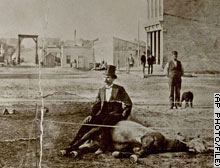
Dismounting a Dead Horse

Take a look at the photo to the left. Why is that elegant man in a tophat sitting on a dead horse? And does it say anything about your life?

This black-and-white photograph was taken in Sheboygan, Wisconsin, between 1876 and 1884 and it has led to nationwide curiosity, speculation and jokes.

The Sheboygan County Historical Research Center has had the picture in its collection for at least 20 years. The Center's director, Beth Dipple, said no one knows who the man is or the circumstances surrounding the photo--only that the city had laws that required people to stay with their dead horses until they were picked up and disposed of.

Does the photo say anything about your life?

Here’s a news flash: “If the horse you’ve been riding has died, dismount.” You don’t keep beating a dead horse, and you don’t keep trying to work a method that doesn’t work. But instead of following this advice, we do a number of other things first. Someone sent this list to me by e-mail. Instead of dismounting a dead horse we:
  • buy a stronger whip (discipline)
  • buy a new saddle (get some new toys and technology)
  • tighten the cinch (control)
  • say things like, “This is the way we’ve always ridden the horse.” (tradition)
  • switch riders (it must the leader)
  • ride the horse for longer periods of time (more meetings, harder work)
  • appoint a committee to study the horse
  • arrange a visit to other sites where they ride dead horses more efficiently
  • write a policy manual for riding (in other words, improve the technique of a process while ignoring that the process isn’t getting you any results)
  • buy some air fresheners and fly strips so we can pretend that the horse we’re riding isn’t really dead
Well, you get the idea. Bottom line, “If what you’ve been trying isn’t working, be willing to try something else.” Proverbs 18:15 (LB) is true: “The intelligent man is always open to new ideas. In fact, he looks for them.”

Are you riding a dead horse?

Thursday, January 04, 2007

Longhorns + Small Boys = 1 Great Blog

There are 200 million blogs which are no longer being updated, say technology analysts. Thankfully, my sister still updates hers when she gets a moment. She's a talented writer with some hilarious stories of life in a 19th-century ranch house with 3 small boys inside and livestock outside. Appropriately, her web journal is called, "Allow Me to Explain . . . ." I usually get to hear her stories at family gatherings long before she has time to post them on her blog. When she gets around to posting her story about the "cat litter lunch" or the time her son embarrassed her in front of his class, I'll be sure to let you know!

Links to Your World--January 4

If you’ve made New Year’s Resolutions, you might want to read about the most famous resolutions of all time: Jonathan Edwards 70 resolutions that he used to guide his life. Find out more here and here.

Time magazine reports on the faith of our late President Gerald Ford in “The Other Born-Again President?”

“They writhe and strut, shake their bottoms, splay their legs, thrust their chests out and in and out again. Some straddle empty chairs, like lap dancers without laps. . . . They are in the sixth, seventh and eighth grades.” That’s from Lawrence Downes New York Times piece, “Middle School Girls Gone Wild.” He says, “Suburban parents dote on and hover over their children, micromanaging their appointments and shielding them in helmets, kneepads and thick layers of S.U.V. steel. But they allow the culture of boy-toy sexuality to bore unchecked into their little ones’ ears and eyeballs.”

From the Hubble: The ten most amazing space photos in the universe here.

In this article, John Cornwell imagines God’s response to Richard Dawkins The God Delusion. Clever.

Don't Be a Pew Potato!

By the time you read this, the game will be over. What game, you ask?
The Texas Tech game that gave Bobby Knight his 880th win?
The UT bowl game squeaker?
The amazing, amazing Boise State win over the Sooners?
None of the above. I’m talking about the Ultimate Couch Potato Contest in Chicago’s ESPN Zone sports bar. Last year’s winner, Jason Pisarik, is back to defend his title. As I write this, the accountant and three challengers have to sit in recliner chairs in front of a 15-foot screen tuned to college football bowl games and inane pre- and post-game commentaries. They are allowed a 5-minute break every hour, but otherwise have to keep their stare on a TV screen and get served food and drink.

The only woman in the competition is holding her own against the men. “I don't know how guys do it,” said Stacy Gleason, a 39-year-old mother of three. “I’m doing this for girls everywhere who don't get to do this while their husbands morph into the furniture watching sports on TV.”

The last man standing--uh, sitting--gets a prize package valued at almost $5,000, including a 42-inch high-definition television, a recliner, gift certificates, and a trophy featuring a live spud.

Pisarik won last year at the 30 hour mark, but the world record is held by Canadian Suresh Joachim who watched TV for an unbroken 69 hours and 48 minutes in September 2005.

Kind of reminds me of the old definition of football: a game played by a bunch of men in desperate need of a break being watched by a bunch of men in desperate need of exercise.

Reading about couch potatoes got me to thinking about another kind of potatoes: the pew potatoes. Every church has an abundance of these sedentary saints who do little more than offer commentary on what others need to do.

Make a new year’s resolution that you won’t be a pew potato in 2007! Get involved in Sunday School or Common Ground on Sunday mornings . . . sign up for a Hillcrest Institute class on Sunday nights . . . attend the “Success to Significance” retreat . . . commit to a mission trip . . . take a volunteer position at church . . . renew your personal prayer life. In other words, put your Christian convictions to work!

God bless your 2007 with him!

(This article was sent to all subscribers of Winning Ways, my weekly e-newsletter to over 700 readers. If you want to subscribe to Winning Ways, click here.)

Thursday, December 21, 2006

Go Tell it On Hog Mountain . . .

Hog Mountain Baptist Church has decided to get a new name. Reading about the whole process of their decision-making made me think about our mission.

For 150 years the church has been know by that venerable name. It’s not the most unusual name I’ve seen for a church. There’s the Jesus Lives Here Methodist Church in Roan Mountain, Tennessee. And in Campbell, Alabama, you’ll find the Witch Creek Baptist Church. There’s the Happy Church in Tuscaloosa, Alabama, or the Welcome Home Baptist Church in Mount Airy, Georgia (Great Hills Baptist Church can loan them some of their bumper stickers). I’m a little curious about why some churches chose their names: Rising Daughter Church in Camden County, South Carolina, or the Hanging Dog Baptist Church in North Carolina.

Hog Mountain Baptist Church was simply named after its community of Hog Mountain, an area in eastern Gwinnett County, Georgia. According to the article, “It was a high place on the ridge of the Eastern Continental Divide, where, the story goes, men would stop overnight while herding hogs to market. White settlers were there before the War of 1812. The Hog Mountain community saw Gwinnett's first courthouse and jail.” For decades, business signs adorned with large porkers proudly proclaimed Hog Mountain this or that.

But in recent years, Gwinnett County has developed considerably, including an upscale golf community. More and more, the area is known as Hamilton Mill. Long-established businesses have dropped “Hog Mountain” from their names in favor of “Hamilton Mill” this or that.

But when members voted to change their 150-year-old church from Hog Mountain Baptist Church to Hamilton Mill Baptist Church, it wasn’t without controversy.

“I think it's a shame to change the name,” said 49-year-old Claudette Miller, who has been a member since she was 12.

That’s what 65-year-old Charles Warbington said, too. “All the old people around here, their hearts are broken. What’re they going to do with the historic marker? Change it?” Not that he’s a member there anymore. According to the article, he’s been in a megachurch up the road for years. But it’s been my experience that moving one’s membership doesn’t keep someone from opining about what their former church ought to be doing.

Even the Gwinnett Historical Society weighed in on the name change. They wrote to the deacons at Hog Mountain Baptist, asking them to reconsider. But the vote passed on December 10.

As I said, reading about the whole event got me to thinking about a church’s mission. I can feel for those long-time members who saw that dropping the name “Hog Mountain” from their church was an act of disloyalty to their community heritage. But I’m on the side of the majority of the members whose eyes were on the future, not the past. Fewer and fewer people moving into the community saw it as Hog Mountain anymore. To them, it was Hamilton Mill. Even most business owners recognized this, and changed the name of long-established businesses.

Ironically, by changing the name, the church was keeping the mission they had known for 150 years. For nearly two centuries, they have ministered to the community known by most residents as Hog Mountain. They’re still ministering to the same community: it’s just that now the community--and the church--is known as Hamilton Mill.

The whole debate in this little church revolved around whether to preserve the church as a museum of past memories or position the church as a mission outpost to the community that has grown up around it.

When I served as pastor of the 175-year-old First Baptist Church in Eastland, Texas, I enjoyed leading worship in their new worship center. Twelve years before my arrival, a visionary pastor had led them to demolish the 1920s-era building so that a new worship center could be built on the site. The architect directed that the Tiffany-style stained glass windows be carefully removed from the old structure and incorporated into the overall design of the new building.

Ten minutes away in a First Baptist Church of another town, the members got a historical marker for their sanctuary.

H-m-m: a historical marker for a building that could never be changed, or a new worship center incorporating the beautiful stained glass of the old building into the fresh design of a new building for a new generation. I think the Eastland church got the better deal.

Do you make you church decisions based upon what will preserve the church’s memories . . . or what will propel the church’s mission?

(This article was sent to all subscribers of LeaderLines, my weekly e-newsletter to ministry leaders. If you want to subscribe to LeaderLines, click here.)

Thursday, December 14, 2006

Physician, Heal Thyself

Those of us who are ministry leaders must remember we’re not just spiritual physicians. We’re spiritual patients, too. We lead others up the discipleship H.I.L.L. while making that vigorous climb ourselves.

Sam Hassenbusch can tell you something about being both a physician and a patient. In the current edition of Texas Monthly, Jan Reid has an article on Hassenbusch called, “Physician, Heal Thyself.” As Reid describes him:

At 51, Sam was full of energy, and his career was peaking. He was a senior neurosurgeon at the University of Texas’s M. D. Anderson Cancer Center, in Houston, and an internationally renowned specialist in pain research and management. . . . His idea of recreation was to turn a three-mile commute in the snarl of Houston traffic into a fifty-mile cruise on his Victory Vegas motorcycle.

But when Sam couldn’t overcome his persistent headaches with Tylenol, he scheduled an MRI. It was when they found glioblastoma, a malignant brain tumor that is one of the most aggressive of all human cancers. Says Reid:

Sam had treated about 500 brain cancer patients in the course of his career, and he had performed more than 150 surgeries to remove glioblastoma tumors. Whenever he had to break the news to patients that they had the cancer, he’d try to be upbeat about chemotherapy protocols and ongoing research, but he knew that glioblastoma typically kills half its victims within 52 weeks. With no hint of a cure, little progress had been made in treating the disease. It was a bitter dose of irony for a brain surgeon at the most celebrated cancer hospital in the Southwest to realize that the very kind of tumor that had most defied his training and skill was now growing inside his skull.

He knew he had a three percent chance of five years’ survival. But he also knew that God would provide for him. Again, from the article:

After his diagnosis, it took Sam about three days to steady himself, to “land on my spiritual base,” as he put it. He was brought up in the Reform Judaism faith in Saint Joseph, Missouri, where he met Rhonda when they were in their teens. He was educated in Catholic school, and one night on a date she gave him a copy of the New Testament as a gift. At Johns Hopkins University, in Baltimore, where he went to undergraduate school and continued with his medical training, picking up a Ph.D. in pharmacology along the way, he became a devout Christian. Sam is a lay biblical scholar and a fundamentalist whose faith is Scripture based. . . . He was an elder of churches when he and Rhonda lived in Maryland and Ohio, and in Houston they had joined a congregation called the Four-Square Church. A large part of its appeal to him was that 20 or 30 percent of the members shared his passion for riding motorcycles.

“In both Judaism and Christianity,” he said, “there’s a Bible passage of great importance: Genesis 22. Abraham is going up Mount Moriah with his son Isaac, who’s saying, ‘Where’s the ram? I thought we were going to make a sacrifice.’ Abraham doesn’t want to tell Isaac he may have to be the one offered, and he says, ‘God will provide,’ ‘Jehovah-jireh’ in Hebrew. And God does. They find the ram stuck in some thorns.” In different ways, through different vessels, he chooses to believe God will provide for him.

The surgery went well, and within a week he was back at work and within two weeks he was back on his motorcycle. Reid says, After he’d gone through the rounds of radiation and initial chemotherapy, he decided that he would keep his head shaved. He thought it enhanced his look as a biker.

Sam has actually become a “lab rat” for a new postsurgical option that he himself proposed, combining a chemotheraphy drug called Temodar with an experimental vaccine. From the article: Conceivably, the experiment could shorten his life, but the research opportunity was almost unparalleled. In addition to giving him a chance to fight the disease, it would enable him to become a part of his own medical team, to inhabit the roles of both patient and doctor in the same case.

So far so good, he says: “This observation from my blood tests on my white cells raises a whole new way that Temodar could be used to treat patients and even crosses over to a possible breakthrough in the treatment of patients with other kinds of tumors. Such is the fun of undergoing double-whammy treatment for the first time in humans with brain cancer.”

As a ministry leader, never forget that you will always be a spiritual patient as well as a spiritual physician. We never get to the point where we won’t have our own issues to deal with, our own knots to untangle, and our own dragons to slay. Even as we see after the soul health of those we lead, we have to see after our own soul, too.

This mentality has a number of benefits. For one, it keeps us from falling into the traps that have caught so many leaders who teach the Word but fail to rigorously monitor their own flaws. Also, openness about the fact that we’re still getting “treatment” from the Great Physician ourselves makes us more effective with those we lead. Someone said that we may be able to impress people from afar, but we’ll only influence people up close. And the only way we can get close with people is to be honest with them about who we really are.

“Praise be . . . to the God of all comfort,” Paul wrote in 2 Corinthians 1:3-4, “who comforts us in all our troubles, so that we can comfort those in any trouble with the comfort we ourselves have received from God.”

(This article was sent to all subscribers of LeaderLines, my weekly e-newsletter to ministry leaders. If you want to subscribe to LeaderLines, click here.)

Wednesday, December 13, 2006

Recommended Film: "Merry Christmas" (Joyeux Noel)


Have you seen “Merry Christmas” (Joyeux Noel). It was nominated for a 2006 Academy Award for Best Foreign Language Film. If you don't like the audio/video quality of the trailer above, you can see a clearer version here.

It's inspired by the true story from the First World War, when something fascinating took place on Christmas Eve 1914. As Ravi Zacharias tells it:

In the midst of an uneasy silence of the guns at night, suddenly a lone voice began to sing a Christmas carol. Irresistibly, another voice joined in, and before one knew it, there was a wave of music because of Bethlehem, cascading across enemy lines, as both sides joined in reading the same script. The story of the babe in a manger, the Prince of Peace, was able to bring communion between warring factions, even for a few hours. This is how a songwriter tells that story. Unfortunately, I can quote only a few stanzas here:

Oh, my name is Francis Tolliver,
I come from Liverpool.
Two years ago the war was waiting
For me after school,
From Belgium and to Flanders,
Germany to here,
I fought for King and country I love dear.

'Twas Christmas in the trenches
And the frost so bitter hung,
The frozen fields of France were still,
No sounds of peace were sung.
Our families back in England
Were toasting us that day,
Their brave and glorious lads so far away

I was lying with me mess-mates
On the cold and rocky ground,
When across the lines of battle came
A most peculiar sound.
Says I, "Now listen up, me boys,"
Each soldier strained to hear
As one young German voice rang out so clear.

"He's singing very well, you know,"
My partner says to me.
Soon one by one each German voice
joined in the harmony.
The canons rested silent
And the gas cloud rolled no more,
As Christmas brought us respite from the war.

As soon as they were finished
And a reverent pause was spent,
"God Rest Ye Merry Gentlemen"
Struck up some lads from Kent.
The next they sang was "Stille Nacht,"
"Tis 'Silent Night,' " says I,
And in two tongues one song filled up the sky.
The film is PG-13 for what the MPAA calls "some war violence and a brief scene of sexuality/nudity." So, keep that in mind. But good film-making here, and a worthwhile story. If you've seen it, or if you decide to, tell me what you think.

Saturday, December 09, 2006

Parody of Mac/PC Commercials

Clever clip. And there are a couple of others from the same creator here.

What To Watch on the Web

If there's nothing good on TV and you're between novels, there's a growing collection of good material on the internet.

For example, go here to view musicians and speakers at Baylor University chapel services. Enjoy outstanding Christian musicians such as David Crowder Band, Steven Curtis Chapman, Robbie Seay Band, Shaun Groves, and others. Also, check out Christian speakers, including Anne Graham Lotz, theologian N.T. Wright, psychiatrist Armand Nicholi, New Testament scholar Ben Witherington III, Ragamuffin author Brennan Manning, popular speaker Neal Jeffrey, and others.

Also, Os Guinness at his elegant best at KU here. You'll find Dr. Guinness among a list of speakers from KU’s “Difficult Dialogues” series. Soon to be posted: Michael Behe, biochemist who’s become a major spokesman for the theory of intelligent design.

On YouTube, you can watch Craig Blomberg. In this video Blomberg assesses the past and present scholarly trends in the search for the historical person of Jesus. This is part 1 of 6. You can find the remaining 5 videos on the YouTube page.

Also, you can watch William Craig Lane. In this video he discusses the origin of the belief in Jesus as the resurrected Son of God.

The Virgin Birth and Christian Faith

“Must one believe in the Virgin Birth to be a Christian? This is not a hard question to answer. It is conceivable that someone might come to Christ and trust Christ as Savior without yet learning that the Bible teaches that Jesus was born of a virgin. A new believer is not yet aware of the full structure of Christian truth. The real question is this: Can a Christian, once aware of the Bible's teaching, reject the Virgin Birth? The answer must be no.”

Read more of Albert Mohler's comments here. Albert Mohler is President of the Southern Baptist Theological Seminary.

Thursday, December 07, 2006

Poems VI: “Totally like whatever, you know?”

Okay, one more and I'm done: Taylor Mali's “Totally like whatever, you know?.” You really need to hear him recite it himself--

In case you hadn't noticed,
it has somehow become uncool
to sound like you know what you're talking about?
Or believe strongly in what you're saying?
Invisible question marks and parenthetical (you know?)'s
have been attaching themselves to the ends of our sentences?
Even when those sentences aren't, like, questions? You know?

Declarative sentences – so-called
because they used to, like, DECLARE things to be true
as opposed to other things which were, like, not –
have been infected by a totally hip
and tragically cool interrogative tone? You know?
Like, don't think I'm uncool just because I've noticed this;
this is just like the word on the street, you know?
It's like what I've heard?
I have nothing personally invested in my own opinions, okay?
I'm just inviting you to join me in my uncertainty?

What has happened to our conviction?
Where are the limbs out on which we once walked?
Have they been, like, chopped down
with the rest of the rain forest?
Or do we have, like, nothing to say?
Has society become so, like, totally . . .
I mean absolutely . . . You know?
That we've just gotten to the point where it's just, like . . .
whatever!

And so actually our disarticulation . . . ness
is just a clever sort of . . . thing
to disguise the fact that we've become
the most aggressively inarticulate generation
to come along since . . .
you know, a long, long time ago!

I entreat you, I implore you, I exhort you,
I challenge you: To speak with conviction.
To say what you believe in a manner that bespeaks
the determination with which you believe it.
Because contrary to the wisdom of the bumper sticker,
it is not enough these days to simply QUESTION AUTHORITY.
You have to speak with it, too.

Poems V: Believe in Poetry, Not Poets

What the poet Octavio Paz said about poetry could just as easily be said about preaching:

"I have a great belief in poetry, but not in poets. Poets are the transmitter, the conduits. They are no better than other people. Poets are vain - we have many defects. We must realize that we are human beings, and be humble. Poetry is very important, but poets are not."
In The Language of Life Bill Moyers says "Octavio Paz--poet, essayist, critic, editor, journalist, and translator--became the first Mexican to receive the Nobel Prize for Literature (1990). A man of conscience, Paz resigned as Mexico's ambassador to India in 1968 to protest his government's massacre of student demonstrators in Mexico City. He has taught at universities around the world and resides today in Mexico City."

Poems IV: "Famous"

Here's one from Naomi Shihab Nye, "Famous"--

The river is famous to the fish.

The loud voice is famous to silence,
which knew it would inherit the earth
before anybody said so.

The cat sleeping on the fence is famous to the birds
watching him from the birdhouse.

The tear is famous, briefly, to the cheek.

The idea you carry close to your bosom
is famous to your bosom.

The boot is famous to the earth,
more famous than the dress shoe,
which is famous only to floors.

The bent photograph is famous to the one who carries it
and not at all famous to the one who is pictured.

I want to be famous to shuffling men
who smile while crossing streets,
sticky children in grocery lines,
famous as the one who smiled back.

I want to be famous in the way a pulley is famous,
or a buttonhole, not because it did anything spectacular,
but because it never forgot what it could do.

Poems III: "Early in the Morning"

Here's another favorite called "Early in the Morning," by Li-Young Lee . . .
While the long grain is softening
in the water, gurgling
over a low stove flame, before
the salted Winter Vegetable is sliced
for breakfast, before the birds,
my mother glides an ivory comb
through her hair, heavy
and black as calligrapher's ink.

She sits at the foot of the bed.
My father watches, listens for
the music of comb
against hair.

My mother combs,
pulls her hair back
tight, rolls it
around two fingers, pins it
in a bun to the back of her head.
For half a hundred years she has done this.
My father likes to see it like this.
He says it is kempt.

But I know
it is because of the way
my mother's hair falls
when he pulls the pins out.
Easily, like the curtains
when they untie them in the evening.
In The Language of Life, Bill Moyers provides this brief bio: "Li-Young Lee was born in Djakarta, Indonesia, to exiled Chinese parents. His grandfather was the first president of the Republic of China, his mother was member of the Chinese royal family, and his father was once personal physician to Mao Tse-tsung. Fleeing persecution in Indonesia, the family wandered through Southeast Asia for five years before arriving in the United States, where his scholarly father became pastor of a small Presbyterian church."

Poems II: "Problems with Hurricanes"

Another favorite poem: "Problems with Hurricanes," by Victor Hernandez Cruz--

A campesino looked at the air
And told me:
With hurricanes it's not the wind
or the noise or the water.
I'll tell you he said:
it's the mangoes, avocados
Green plantains and bananas
flying into town like projectiles.

How would your family
feel if they had to tell
The generations that you
got killed by a flying
Banana.

Death by drowning has honor
If the wind picked you up
and slammed you
Against a mountain boulder
This would not carry shame
But
to suffer a mango smashing
Your skull
or a plantain hitting your
Temple at 70 miles per hour
is the ultimate disgrace.

The campesino takes off his hat--
As a sign of respect
towards the fury of the wind
And says:
Don't worry about the noise
Don't worry about the water
Don't worry about the wind--

If you are going out
beware of mangoes
And all such beautiful
sweet things.

Poems I: Otherwise

Posting that poem by Garrison Keillor got me to thinking about other poems I've collected over the years. Here's Jane Kenyon's "Otherwise"--

I got out of bed
on two strong legs.
It might have been
otherwise. I ate
cereal, sweet
milk, ripe, flawless
peach. It might
have been otherwise.
I took the dog uphill
to the birch wood.
All morning I did
the work I love.

At noon I lay down
with my mate. It might
have been otherwise.
We ate dinner together
at a table with silver
candlesticks. It might
have been otherwise.
I slept in a bed
in a room with paintings
on the walls, and
planned another day
just like this day.
But one day, I know,
it will be otherwise.

"His Mountains All Uncrossed"

Why do these lines from a Garrison Keillor poem always choke me up? This is from his 1987 book, Leaving Home:

Our people aimed for Oregon
When they left Newburyport
Great-grandma Ruth, her husband John,
But they pulled up in Wobegon,
Two thousand miles short.

It wasn't only the dangers ahead
That stopped the pioneer.
My great-grandmother simply said,
"It's been three weeks without a bed.
I'm tired. Let's stay here."

He put the horses out to graze
While she set up the tent,
And they sat down beside their blaze
And held each other's hand and gazed
Up at the firmament.

"John," she said, "what's on your mind
Besides your restlessness?
You know I'm not the traveling kind,
So tell me what you hope to find
Out there that's not like this?"

The fire leapt up bright and high,
The sparks as bright stars shone.
"Mountains," he said. "Another sky.
A green new land where you and I
Can settle down to home.

"You are the dearest wife to me.
Though I'm restless, it is true,
And Oregon is where I'd be
And live in mountains by the sea,
But never without you."

They stayed a week to rest the team,
Were welcomed and befriended.
The land was good, the grass was green,
And slowly he gave up the dream,
And there the journey ended.

They bought a farm just north of town,
A pleasant piece of rolling ground,
A quarter-section, mostly cleared;
He built a house before the fall;
They lived there forty years in all,
And by God persevered.

And right up to his dying day
When he was laid to rest,
No one knew -- he did not say --
His dream had never gone away,
He still look to the west.

She found it in his cabinet drawer:
A box of pictures, every one
Of mountains by the ocean shore,
In the mountains he had headed for
In the state of Oregon.

There beside them lay his will.
"I love you, Ruth," the will began,
"And count myself a well-loved man.

Please send my ashes when I die
To Oregon, some high green hill,
And bury me and leave me lie
At peace beneath the mountain sky,
Off in that green and lovely land
We dreamed of, you and I."

At last she saw her husband clear
Who stayed and labored all those years,
His mountains all uncrossed.
Of dreams postponed and finally lost,
Which one of us can count the cost
And not be filled with tears?

And yet how bright those visions are
Of mountains that we sense afar,
The land we never see:
The golden west and golden gate
Are visions that illuminate
And give wings to the human heart
Wherever we may be.
That old man by dreams possessed,
By Oregon was truly blessed
Who saw it through the eye of faith,
The land of his sweet destiny:
In his eye, more than a state
And something like a star.

I wrote this poem in Oregon,
Wanting the leaden words to soar
In memory of my ancestor
And all who lie along the way.
God rest their souls on the golden shore,
God bless us who struggle on:
We are the life that they longed for,
We bear their visions every day.

Wednesday, December 06, 2006

Record-Breaking Striper!


John Erskine, my future brother-in-law, caught a state record striper on Saturday, December 2, from the Guadalupe river.

It beat the previous record by 14 pounds. It was 36.65 pounds and 43 inches long, caught on a fly rod.

Find out more about it on his website, along with more photos.

Congrats to John!

Tuesday, December 05, 2006

Psychological Warfare in Waco

Pop quiz: Who said the following:

"My tertiary specialty in the Air Force was psychological warfare, and I was no mean student thereof. It is imperative to know everything conceivably possible about your adversaries and their soft underbelly -- and have the patience to await the most strategic moment to strike."

(a) Karl Rove
(b) Jack Bauer
(c) Abu Musab al-Zarqawi

None of the above. It was written by Herbert Reynolds, past president of Baylor University, in an e-mail threat to Baylor personnel planning to release a book. The working title is Baylor Beyond the Crossroads: A Story of Aspiration and Controversy. The book covers the last few years at Baylor where controversy surrounded President Robert Sloan's "2012 Vision" designed to raise Baylor into the top echelon of research universities while strengthening its Christian character.

Reynolds sent a long, threatening e-mail, including the quote above, and the university backed out of their plans to publish the book. Now the book is in need of a new publisher.

The Chronicle of Higher Education has an article on the controversy. The site requires subscription, but you can read the article for free here. Dr. Sloan, a contributor to the book and now the new president at Houston Baptist University, expressed disappointment that Baylor's press was pulling the project: “I think it's always unfortunate when people give in to external pressure to suppress information. This is a very collegial disagreement that needs to be aired. That's why we have universities and books like these. The suppression of a book -- or threats that some have made if a book is published -- is completely antithetical to Baptist principles of academic freedom and open discussion."

Hear, hear.

I'm looking forward to reading the book when they get it published.